Building an online presence used to be simple. You put up a basic homepage, added a contact form, listed your phone number, and called it a day. But if you’re running a business today, your website isn’t just a digital brochure. It’s your main storefront, your primary sales agent, and the operational hub for your whole digital setup.
When it comes to building or upgrading that hub, you usually land at a critical fork in the road: should you build a quick site using a drag-and-drop website builder like Wix, Squarespace, or generic Shopify themes, or invest in custom web development?
At first glance, website builders look like an absolute steal. They promise cheap monthly plans, zero coding requirements, and stunning pre-made templates that let you go live in an afternoon. But as your traffic grows, your product lineup expands, and your marketing gets more complex, those slick templates often hit a brick wall.
Let’s look into how custom code and website builders compare across real-world performance, long-term costs, technical SEO, and scaling potential, so you can figure out what actually makes sense for your business goals.
The True Cost of Convenience: How Website Builders Work
Website builders exist for one main reason: accessibility. They let anyone set up a clean, functional site without typing a single line of HTML or CSS. For a solo freelancer, a local neighborhood cafe, or an early-stage hobby project, that convenience is hard to beat.
However, that ease of use relies on heavy abstraction under the hood. To let non-developers drag, drop, resize, and style elements on a screen visually, website builders rely on massive, standardized software frameworks.
1. Code Bloat and Slower Performance
When you use a visual page builder, the platform automatically generates the code in the background. Because that generator has to account for every possible design tweak, layout option, and widget a user might add, it loads bloated JavaScript libraries, inline CSS styling, and unused external scripts on every single page.
This extra code directly impacts your site’s speed. According to research published on Google’s Web Developer Performance Benchmarks, every extra second a mobile page takes to load drops conversion rates significantly. When your core codebase is locked inside a proprietary visual builder, cleaning up that back-end bloat is nearly impossible.
2. Platform Lock-In
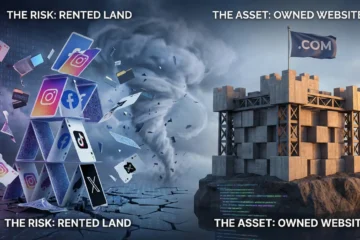
When you build on a closed DIY platform, you don’t actually own your software—you’re essentially renting digital space on someone else’s infrastructure.
- You can’t migrate your core database files seamlessly to a private server.
- You can’t tweak server-level caching configurations.
- If the platform changes its pricing models, updates its feature terms, or discontinues a critical tool, you just have to adapt to it.
If your business scales past the feature set offered by that closed platform, moving to a new setup often means scrapping everything and starting completely from scratch.
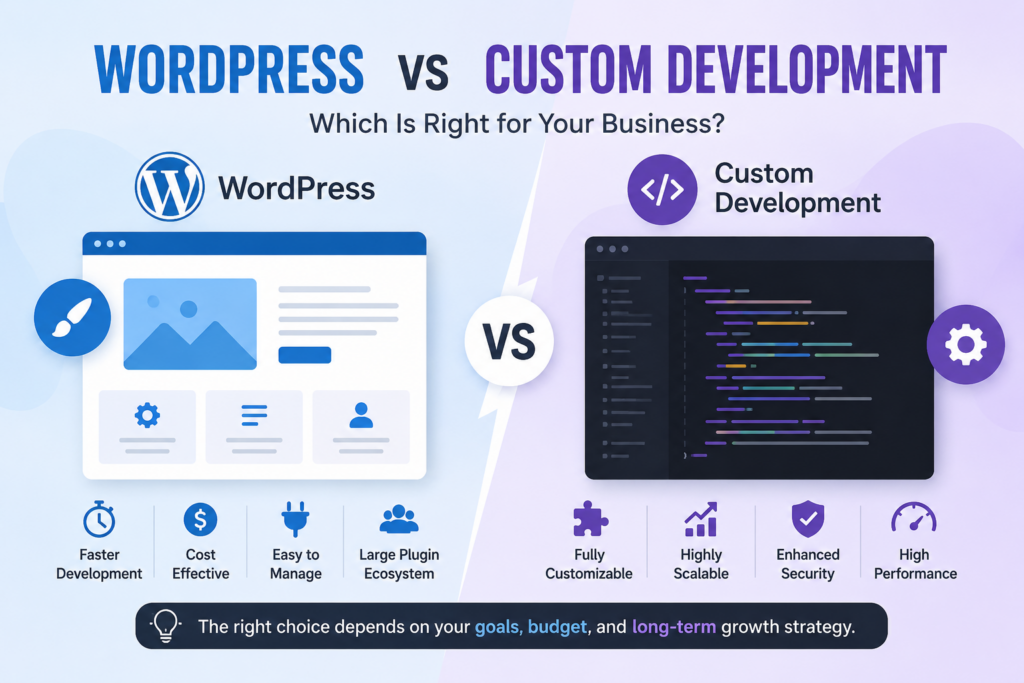
What Is Custom Web Development?
Custom web development isn’t just about writing code from scratch for the sake of it. It’s an approach where your site’s architecture, user interface, database structure, and feature sets are designed specifically around your business operations and target audience.
Instead of stretching a rigid template to fit your workflows, custom development builds the technology directly around how your business sells, collects leads, and serves customers.
+-------------------------------------------------------------------+
|                     CUSTOM WEB DEVELOPMENT                        |
+-------------------------------------------------------------------+
| - Clean, minimal codebase tailored to exact feature requirements |
| - High Core Web Vitals performance and sub-second load times     |
| - Full data control, custom integrations, and server ownership    |
| - Uncapped scalability with zero platform-enforced limits        |
+-------------------------------------------------------------------+
                                 vs
+-------------------------------------------------------------------+
|                        WEBSITE BUILDERS                           |
+-------------------------------------------------------------------+
| - Heavy, auto-generated code bloat with unused script files       |
| - Slower baseline performance and rigid technical SEO limits      |
| - Platform lock-in (rented infrastructure, zero database export)  |
| - Strict functional ceilings that limit scaling options           |
+-------------------------------------------------------------------+
Key Technical Advantages of Custom Development
- Tailored Codebase: You only load the exact CSS, HTML, and JavaScript your pages need to function, leading to super-fast load times.
- Complete Database & API Control: Connect your site directly to your internal CRM, custom inventory trackers, specialized payment channels, or custom client portals without relying on buggy third-party plugins.
- Full Data Ownership: Your site files, databases, and customer records belong completely to you. You can host them wherever you want, tweak server protocols, or scale your hardware whenever traffic spikes.
5 Critical Areas Where Scaling Businesses Hit the “Template Wall”
If your business aims to grow consistently over the next few years, template builders usually run into major hurdles in five key areas:
1. Speed and Core Web Vitals
Google uses performance signals known as Core Web Vitals (Largest Contentful Paint, Interaction to Next Paint, and Cumulative Layout Shift) to evaluate user experience and rank search results.
                               CORE WEB VITALS
                                      |
       +------------------------------+------------------------------+
       |                                                             |
   [  LCP  ]                                                     [  INP  ]
Largest Contentful Paint                                   Interaction to Next Paint
(Target: < 2.5s)                                           (Target: < 200ms)
       |                                                             |
 Measures perceived loading speed                             Measures user input responsiveness
       |                                                             |
 (Hurt by heavy bloat/images)                                (Hurt by excessive main-thread JS)
Website builders struggle here because they load heavy render-blocking assets and third-party tracking scripts before your main content even shows up on screen.
Custom web development lets engineers split code logically, lazy-load heavy media assets, implement advanced server-side rendering (SSR), and deliver pages instantly. That performance gap doesn’t just improve your search rankings—it gives visitors a seamless, premium experience.
2. Search Engine Optimization (SEO) Architecture
Basic on-page SEO—like changing page titles, updating meta descriptions, and adding heading tags—is easy on almost every platform today. But complex technical SEO is where the real separation happens.
Custom web platforms give you total freedom to:
- Set up custom, dynamic XML sitemaps.
- Control canonical URL rules across complex product categories.
- Implement custom structured data schema (
Organization,Product,Article,LocalBusiness, andFAQPage) directly in the page markup. - Optimize server response times (TTFB) at the hosting level.
When search engines crawl a custom-built, lightweight site, they index pages faster and consume far less crawl budget compared to navigating a heavy, script-heavy builder platform.
3. User Experience (UX) and Brand Identity
Templates are built for the masses. That means your competitors have access to the exact same layouts, color schemes, and navigational patterns you do.
If your goal is to build a distinct brand identity, a generic template instantly hurts your credibility. Custom development gives you absolute creative freedom. You can build unique interactive features, custom price calculators, dynamic lead intake forms, and tailored user dashboards that feel like a natural extension of your company.
4. Custom API Integrations & Automation
As businesses scale, efficiency comes down to automation. You don’t want your team spending hours manually copying contact form entries into your email marketing tool or double-checking inventory numbers across different platforms.
+------------------+         +------------------+         +------------------+
|  Custom Website  | <=====> |  API Integration | <=====> |   Internal CRM   |
|   Frontend App   |   REST  |  Engine / Webhook|  Secure |  / ERP Platform  |
+------------------+  /gRPC  +------------------+  Tokens +------------------+
While builder platforms offer basic app stores with simple plugins, those plugins often run into limitations:
- They charge recurring monthly app subscription fees that quickly stack up.
- They slow down your site by adding external tracking code and scripts.
- They break when the core platform updates its software.
- They rarely offer true, two-way data sync for custom operational needs.
Custom sites let developers integrate directly with official REST or GraphQL APIs, building secure, automated data pipelines that match your exact business processes.
5. Security Vulnerabilities and Plugin Dependency
Most DIY websites rely heavily on third-party plugins or apps to add essential features like pop-up forms, image sliders, or custom checkouts.
Every extra plugin you install adds a new potential entry point for attackers. According to security studies indexed by OWASP (Open Web Application Security Project), unpatched third-party plugins and extensions cause a vast majority of web application breaches.
Custom platforms cut out unnecessary external dependencies by building needed features straight into the core codebase. This drastically reduces your attack surface and keeps your database secure.
Comparing the Options: Custom Web Dev vs. Website Builders
Here is a side-by-side look at how custom web development compares to template-based website builders across the board:
| Evaluation Feature | Website Builders (Wix, Squarespace, Generic Themes) | Custom Web Development (Tailored Codebase) |
| Upfront Cost | Very low initial investment. | Higher initial capital investment. |
| Time to Launch | Days or weeks. | Weeks or months depending on feature scope. |
| Page Speed & Core Web Vitals | Average to slow due to pre-packaged code bloat. | Blazing fast; built for high performance. |
| Technical SEO Control | Basic. Limited to default platform options. | Full control over server headers, schema, and site structure. |
| Custom Functionality | Restricted to available third-party plugins. | Completely unlimited. Built around your unique needs. |
| Design Originality | Template-driven; looks similar to other sites. | 100% unique, built to match your brand identity. |
| Data Ownership & Hosting | Locked to the platform’s proprietary servers. | 100% full ownership. Host on any cloud platform. |
| Long-Term Scaling Potential | Low. Hits functional limits as traffic expands. | Uncapped. Scales smoothly with your growing business. |
When Does a Website Builder Make Sense?
To be fair, custom development isn’t always necessary for every single project from day one. A website builder can be the right call if:
- You are testing a brand-new business idea: If you need to validate a product concept quickly without committing significant funds, build a simple landing page on a builder first.
- You have zero budget: If your initial capital is very tight, spending your entire budget on a custom site before you have proven demand can be risky.
- You run a simple local business: If you only need a single page listing your business hours, contact phone number, address, and a simple service menu, a template platform might handle your needs just fine.
When Should You Switch to Custom Web Development?
If your business is past the initial launch phase and actively scaling, a template builder can quickly turn into a bottleneck that holds back your growth. You should move to custom web development if:
- Your monthly ad spend is scaling: If you are spending heavily on Google Ads, Meta Ads, or social media campaigns, driving paid traffic to a slow template page wastes money. Dropping your page load time even slightly can increase conversions enough to pay for custom development quickly.
- You need unique workflows: If your business model involves subscription management, complex booking systems, custom calculators, or tiered customer portals, custom development provides the exact functionality you need.
- Your organic traffic has plateaued: If you are trying to rank for competitive keywords, but bad technical SEO or slow Core Web Vitals scores are holding you back, a clean custom architecture can give you a real competitive edge.
- You want to build real brand equity: A clean, fast, custom-designed site shows prospective clients that you take your business seriously. It establishes instant trust and positions you as an established market leader.
How Custom Development Drives Real Business Growth
At CrystalJenix Technologies, we don’t treat web development as just writing code or stringing together visual layouts. We build fast, high-converting digital assets designed specifically around your business goals.
By combining clean software architecture with conversion-focused design and technical SEO, custom web development turns your site into a core engine for long-term growth.
Instead of fighting template limits, dealing with slow load speeds, or paying monthly fees for fragile third-party apps, custom code gives you total control over your digital footprint. You get a fast, secure, unique web application that scales seamlessly alongside your business.
Summary Checklist: Making the Right Choice
Before deciding on your next web development project, ask yourself these core questions:
- [ ] What are my primary growth goals for the next 12–24 months?
- [ ] Is site performance directly impacting my ad campaigns or search rankings?
- [ ] Do I need specialized features that standard templates and plugins can’t handle properly?
- [ ] Am I ready to invest in a proprietary digital asset that my business fully owns?
If you answered yes to those performance and growth goals, moving past simple website builders and investing in custom web development is usually the smartest move for your business.
Ready to build a fast, high-converting website tailored to your business? Let’s discuss your project and map out a custom web development strategy today.